


If pickleball has started to feel harder on your body than it used to, there’s a good chance nothing is “wrong” in the way most players assume.
The game has simply changed.
Rallies now unfold faster and anticipation has become a bigger advantage. Players are committing to movement sooner and positioning themselves before the ball ever leaves the paddle. The brain has adapted quickly. The body, in many cases, has not.
That disconnect is where balance starts to feel unreliable.
Most players notice it first indoors. You reach the right spot, but you don’t always feel settled when you get there. What’s happening is not a loss of balance. It’s a delay in when balance shows up.
The Timing Gap Most Players Don’t Realize They’re Dealing With
When movement begins to feel off, players usually blame age, speed, or conditioning. Those factors can matter, but they’re rarely the root issue.
The real problem is timing.
As pickleball has sped up, the brain has learned to commit earlier. The feet, however, don’t always stabilize quickly enough to support those early decisions. The result is a small but meaningful gap between deciding to move and having a stable base underneath you.
That gap is called stability lag.
Stability lag shows up when your intention is solid, but your foundation arrives a moment late. You feel early to the ball, yet slightly rushed. Lateral movement requires a last-second adjustment and recovery steps may feel hurried instead of automatic.
Over the course of a match, they add up. The body spends more energy fixing movement than finishing it.
How Stability Lag Turns Into Injury Over Time
Most pickleball injuries don’t come from one bad step or one awkward landing.They develop when sound movement patterns are repeated on a slightly unstable base.
When stabilization is delayed, force doesn’t travel cleanly through the body. Ankles absorb last-second corrections and the Achilles gets loaded during rushed push-offs when the body really needs a stable platform to launch from.
Problems come from repetition under instability, especially in a sport that demands constant lateral movement and quick recovery.
What the Balance Study Actually Revealed

In April 2025, physicians and biomechanical researchers conducted the first real-world clinical study on pickleball footwear balance, analyzing adult players during live play using hospital-grade motion capture. Shoes were tested head-to-head under the same conditions to see how different designs affected stability during real pickleball movement.
The results were consistent. SQAIRZ XRZ™ outperformed every major athletic brand tested across balance and stability measures, with players improving balance scores by as much as 26.5%. More importantly, players stabilized sooner and needed fewer corrective steps during lateral movement and recovery.
The study showed that improved underfoot stability doesn’t change how players play or force them to slow down. It simply allows the base to arrive when it’s needed, making movement feel cleaner, more controlled, and easier on the body.
Why Footwear Plays a Bigger Role Than Most Players Think

Balance depends on more than one thing working together, but footwear is the factor most players underestimate. Shoes sit at the very end of the movement chain, and when that connection to the court feels delayed or inconsistent, the body has to compensate higher up. Those compensations create unnecessary stress and make movement feel rushed instead of controlled.
When ground response is reliable, the gap between deciding to move and feeling supported shrinks. When it isn’t, that gap grows. That insight is what guided the design of XRZ™.
How XRZ™ Is Designed to Reduce Stability Lag

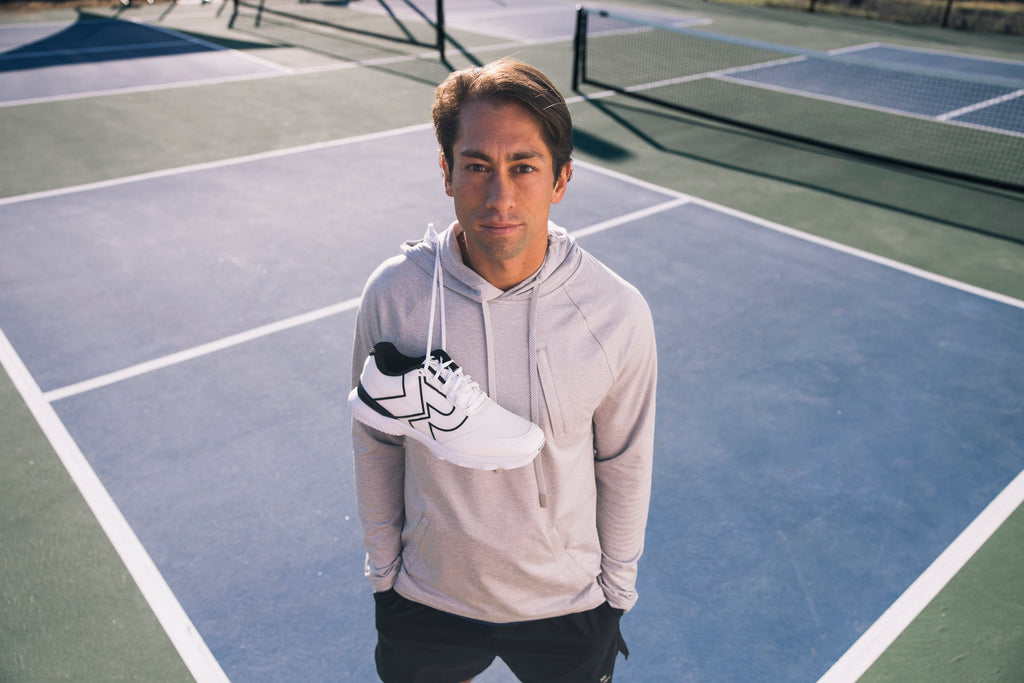
XRZ™ Pickleball Shoes were built with balance as the starting point.
Key elements work together to help the body stabilize sooner:
-
Lower profile = more control. XRZ™ sits flatter to the ground, eliminating the dangerous “tilt” of cushioned running shoes.
-
Structured support = joint alignment. A reinforced heel counter and lateral outrigger keep your foot centered — so your hips, knees, and ankles move in sync.
-
Roomier toe box = better balance. Our patented design allows your toes to splay naturally, increasing ground contact and stability.
-
Comfort without compromise. The new GripSync™ removable insole provides responsive cushioning while maintaining your connection to the court.
XRZ™ is clinically tested, Medicare-approved for balance improvement and fall-risk reduction, and named the #1 Pickleball Shoe by Pickleheads.
That recognition reflects what players experience when their base responds as quickly as their brain.
The Goal Going Forward
The goal isn’t slower play. The goal is earlier stability.
If movement has felt rushed, recovery has felt tight, or balance has felt unpredictable indoors, that isn’t athleticism slipping away.
It's a stability lag. And it’s fixable.
