


If you’re serious about improving your game this year, the two-handed backhand is worth adding.
It’s not just something you’re seeing more often on tour for no reason. As rallies get faster and players have less time to react, having a more stable, controlled backhand becomes a real advantage.
Zane Navratil breaks down how it works, when to use it, and how to start building it into your game.
Why It’s Showing Up More
The biggest difference with a two-handed backhand is how connected the shot feels.
Instead of relying on just your arm, you’re using your core, shoulders, and balance together. That gives you more control through contact and a lot more confidence in situations where a one-handed backhand might break down.
You’ll notice it most on higher balls, faster exchanges, and anything that requires a quick adjustment. You’re able to generate more pace without overswinging, keep the paddle more stable, and react just a bit later while still making clean contact.
Even small things, like making contact slightly closer to your body, start to matter when the game speeds up.
How to Build It Into Your Game
Most players start with a continental grip in the dominant hand, with the non-dominant hand placed just above it.
From there, the focus is less on a big swing and more on staying compact and connected. The power comes from your torso rotating through the shot, not your arms trying to do everything.
A simple way to feel this is by taking your dominant hand off the paddle and dinking with just your non-dominant hand. It sounds simple, but it forces you to understand where the control and spin are actually coming from.
Once you add your dominant hand back, the motion starts to feel much more natural.
Where It Makes the Biggest Difference
This is where the two-handed backhand starts to separate itself.
It shows up on baseline drives when you want more topspin and pace, on counters when rallies speed up, and on high backhand balls where one hand tends to lose stability.
It’s also what allows players to disguise shots better. The same setup can turn into a dink, a speed-up, or a reset depending on how you adjust at the last second.
At the core of all of it is balance.
If you’re stable through contact, you have more options. If you’re not, you’re usually just trying to survive the point.
That balance doesn’t just come from your hands. It starts with how stable you are through your feet.
When you’re hitting a two-handed backhand, especially in faster exchanges, your ability to stay centered and controlled depends on how well you’re connected to the ground. If your base is off, you’ll feel it right away in your timing and contact.
Gear That Supports the Movement
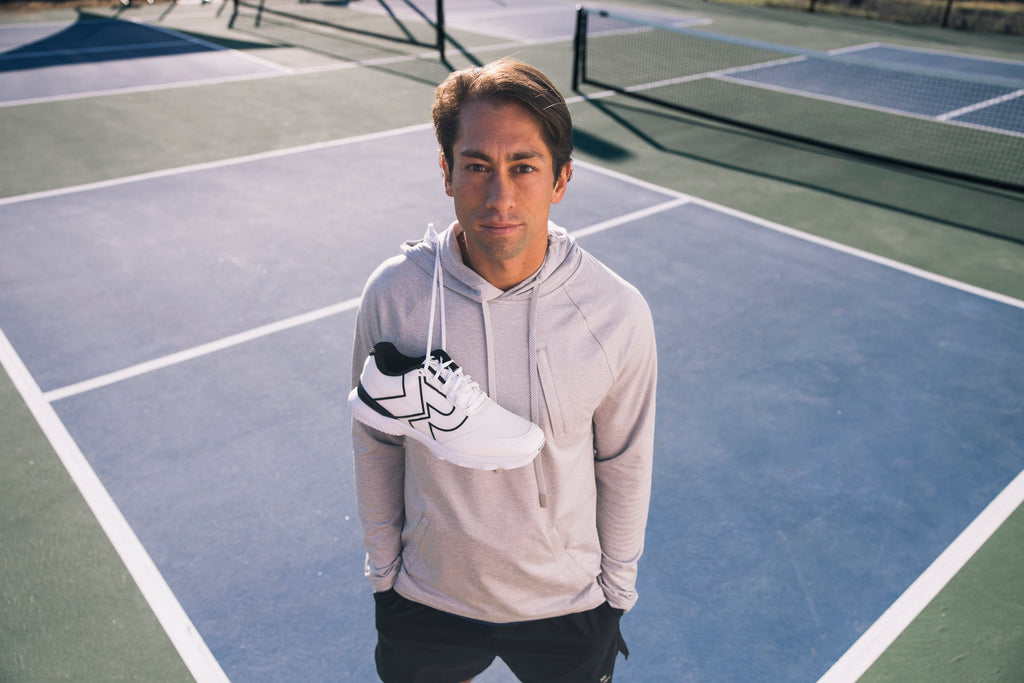
Zane Navratil plays in the XRZ™ Pickleball Shoe, built to support balance and ground connection during fast, lateral movement.
The XRZ™ features a patented roomier toe box that allows your toes to engage naturally, creating a more stable base under the ball of the foot. Combined with a lower-profile design and reinforced lateral support, it helps you stay centered through contact instead of drifting or compensating.
When your base is stable, shots like the two-handed backhand become easier to control and repeat.


