Pitchers spend a lot of time chasing arm speed. But most delivery issues don’t start in the arm. They start earlier, right when the front foot hits the mound.
That moment decides whether the rest of the throw feels smooth or forced. Whether energy moves cleanly up the chain or leaks out before it ever reaches release.
This is where footwear matters more than most players realize.
The Pitching Delivery Is A Sequence
Every pitch follows an order.
Force starts in the ground.
It moves through the legs.
The hips rotate.
The torso follows.
The arm delivers the ball.
When that sequence stays intact, throwing feels connected. When it doesn’t, the arm usually ends up doing more than it should.
Research into pitching biomechanics consistently shows that lower-body force production, pelvic control, and trunk timing are all tied to both velocity and joint stress. The hips and glutes are drivers.
But those muscles can only do their job if the body feels stable enough to use them.
Why The Front Foot Is The Gatekeeper
Your stride foot has one main responsibility:
create a stable post your body can rotate around.
When that foot lands, your body needs to stop moving forward and start rotating almost immediately. If the foot feels solid, the hips can fire on time. If it doesn’t, the body delays rotation or finds stability somewhere else.
That’s when pitchers start gripping the ground with their toes, stiffening the ankle, or rotating early with the upper body. Those are compensation strategies that pull work away from the hips and glutes.
Over time, that shows up as timing issues, inconsistency, and extra stress on the arm.
Toe Splay And Why It Matters In Pitching
When your foot hits the mound, your toes naturally want to spread. That’s how the body increases balance and stability.
More toe spread creates a larger base of support.
A larger base makes it easier to accept force.
Cleaner force acceptance allows faster front-side bracing.
That gives the hips a stable platform to rotate against.
This chain reaction is simple, but powerful. When the forefoot is constrained or unstable, the body has to work harder just to feel balanced. When the forefoot is stable, the body can rely more on proximal muscles, especially the glutes, to drive the delivery.
That’s where sequencing improves.
Where Cleat Design Enters The Picture

Cleats control how your foot interacts with the ground. Toe box shape, platform width, traction layout, and midsole stiffness all influence whether the foot settles confidently or fights for balance.
Many mainstream baseball cleats are built around speed-first priorities — lightweight materials, narrow silhouettes, and responsive cushioning.
Pitching places different demands on the foot.
Landing hard on a mound and rotating at high speed requires stability more than lightness. For some pitchers, especially those with wider feet or higher force demands, a narrow or overly compliant forefoot can reduce functional stability right when it matters most.
How SQAIRZ GFP™ Cleats Are Engineered Differently

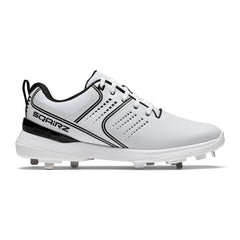
SQAIRZ GFP™ baseball cleats were designed with one goal in mind: improving the foot–ground connection so the body can sequence efficiently.
Key design elements include:
-
Patented roomier forefoot geometry
Allows natural toe splay at landing, increasing the functional base of support. -
Stable platform under load
Built to resist collapse during front-side bracing and rotation. -
SmartTraction™ outsole
Engineered to support braking, rotation, and push-off rather than straight-line sprinting alone. -
Model options for every surface
GFP™ Metal, GFP™ Molded, and GFP™ Turf so pitchers can keep the same platform feel in games and training.
The intent isn’t to change mechanics. It’s to reduce instability and compensation so the hips and glutes can contribute the way they’re meant to.
How SQAIRZ Compares To Other Major Cleat Brands

Different brands solve different problems:
-
Nike
Emphasizes speed, responsiveness, and lightweight construction. Narrower speed silhouettes can feel fast but may limit toe splay for some pitchers. -
Adidas
Focuses on minimal mass and quickness platforms, often using speed-oriented lasts. -
Under Armour
Blends comfort and traction systems, sometimes prioritizing cushioning and a running-shoe-like feel. -
New Balance
Leans into cushioning and plate engineering, offering a balance of comfort and support depending on the model.
SQAIRZ differentiates itself by making forefoot stability and toe freedom the primary performance lever, especially for athletes who land hard and rotate fast.
What Pitchers Actually Notice
When sequencing improves, pitchers don’t talk about biomechanics.
They say things like:
-
“My landing feels stronger.”
-
“I don’t feel like I’m slipping anymore.”
-
“My hips fire without me forcing it.”
-
“My arm feels smoother later in games.”
Those sensations line up with what biomechanics predicts when the lower body is allowed to lead consistently.
Proven Credibility Beyond Theory
SQAIRZ GFP™ cleats are the first baseball shoes clinically recommended by ACFAS, reflecting their emphasis on foot mechanics and stability.
SQAIRZ is also:
Those partnerships exist because the shoes perform under real competitive demands.
The Takeaway
Pitching efficiency depends on how well energy moves from the ground up. The foot sets the conditions for that transfer.
SQAIRZ cleats are built to reduce instability so the hips and glutes can do the work they’re designed to do. When the base is stable, the sequence has a better chance to stay intact and the arm doesn’t have to do everything.
If you want the full biomechanical breakdown and detailed figures behind these concepts, you can read the complete white paper linked here.
But if you want gear that feels different on your feet and performs different on the field, shop the lineup built for performance: